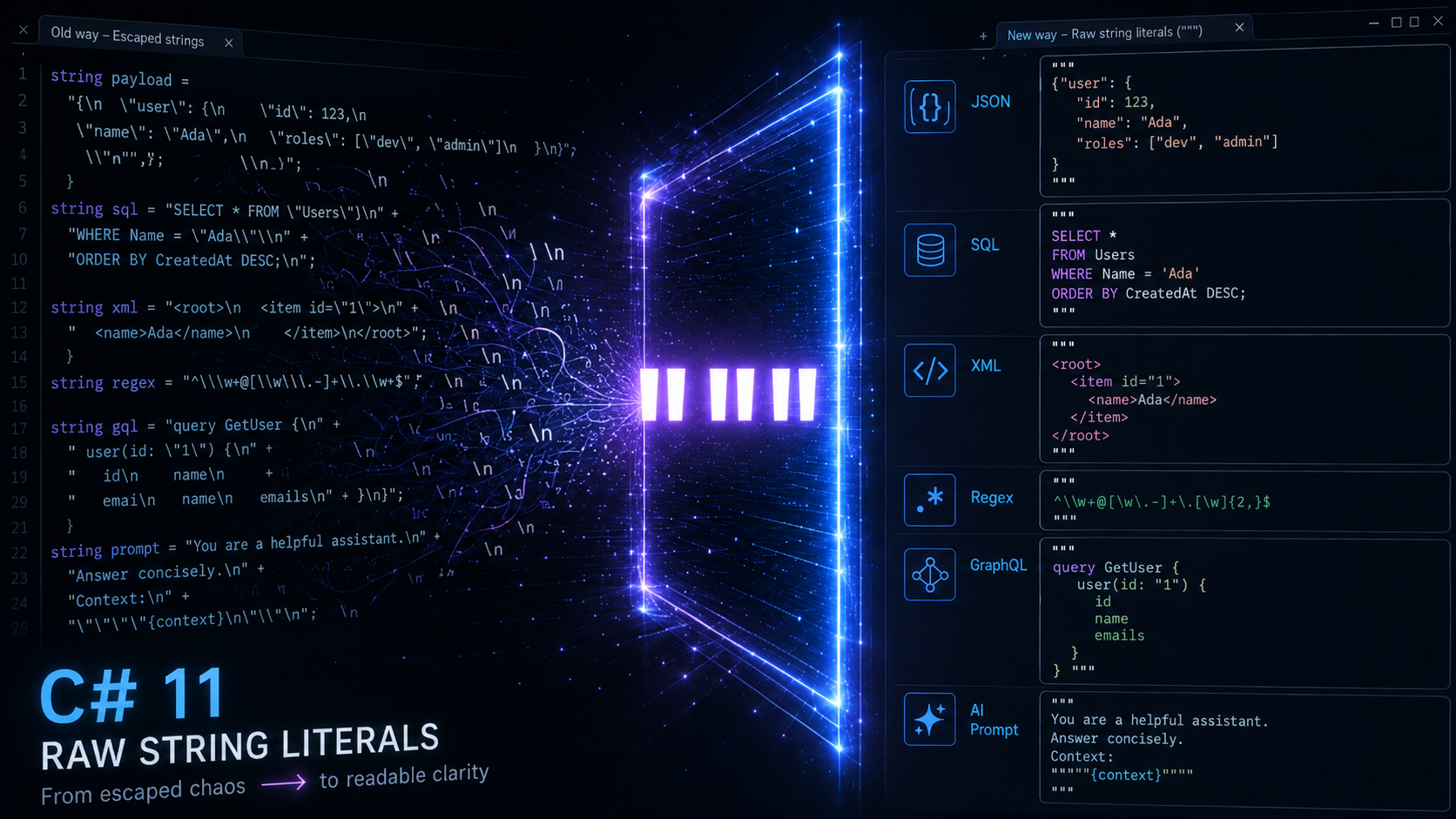
Raw string literals in C# 11 use triple-or-more quotes to embed JSON, regex, and SQL without escape gymnastics. Here is when to use them over @" and $" forms.
A practical comparison of Azure Functions in containers vs PaaS, including tradeoffs around scaling, control, portability, and operations.
A practical guide to UTF-8 string literals in C# 11, including how the u8 suffix works, why it matters for performance, and when to use it in .NET.
How generic attributes in C# 11 work, what problems they solve, and where they fit into modern .NET codebases.
Learn how custom string interpolation works in C#, how InterpolatedStringHandler changes string interpolation, and when it can improve formatting and performance.
Using tuple pattern matching in C# to write clearer conditional logic and simplify branching across multiple values.
How the Interface Segregation and Open/Closed principles overlap and differ in C#, with examples that show when each leads to better design.
A practical look at the Interface Segregation Principle in C# and how smaller interfaces reduce coupling and improve design.
A practical C# example of the Open/Closed Principle and how it supports extensible designs with fewer code changes.
A practical C# example of the Single Responsibility Principle and how focused classes improve maintainability and changeability.
I used params because I need to pass in eight string arguments which I was preforming more or less the same operations on.
T4 is an engine built into Visual Studio for code generation. It has been around since VS 2005 and I have been playing with it for a while.